
What to do after a Design Sprint: how to turn sprint insights into real ROI
Written by Luke James Taylor, Design Sprint X Co-Founder

There's a moment that happens at roughly 4pm on the final day of a Design Sprint. The last customer has finished testing the prototype. The team is tired, wired, slightly emotional. Someone orders food. Someone else says the words "that was incredible." There's a genuine feeling in the room: we just did something real.
And then everyone goes home for the weekend.
What happens in the seven days after that moment is what determines whether the sprint was a week well spent or another expensive event that produced a great Miro board, a few quote cards for LinkedIn, and not much else.
The uncomfortable truth is this: most teams are brilliant at the sprint itself and quietly fumble what comes next. Not because they're lazy or disorganised. Because nobody told them the sprint is just the beginning — and that the real work, the execution work, has its own rules.
This article is the guide they needed. If your team has just finished a sprint, or is about to run one, what follows is the post-sprint playbook that actually protects the value you've created.
Why the post-sprint period is where value dies
The sprint itself is, counterintuitively, the easy part. You've got five days blocked out in the calendar. The right people are in the room. There's a clear structure, a facilitator keeping the energy moving, and a shared focus that most teams never experience in their normal working week.
The week after has none of those things. The facilitator leaves. The team scatters back to their day jobs, their other projects, their inboxes. Every competing priority that was briefly suspended comes flooding back at once.
"The sprint gives you the answer. The post-sprint is where you decide whether to use it."
This is the structural problem. Design Sprint methodology has spent years refining what happens inside the five days. The days have names. The activities have timings. The Friday has a customer interview protocol. But the calendar entry for Monday of the following week? That's typically blank.
The result is predictable. Most value gets lost not in the sprint, not in the decision — but in the handover. In the gap between "we know what to do" and "someone is actually doing it."
Teams that point to outputs — workshops run, ideas generated, prototypes built — rather than outcomes — problems solved, products shipped, decisions made — are teams where the post-sprint handover broke down. The sprint was real. The follow-through wasn't.
The 48-hour rule: what must happen before Tuesday
There is a window right after a sprint where the team is uniquely positioned to move. The insights are fresh. The prototype is in everyone's heads. The exact language from the Friday customer interviews is still live in memory.
That window starts closing Sunday evening. By the middle of the following week, without action, sprint momentum is already leaking.
The rule: within 48 hours of the sprint ending, three specific things must happen. Not "sometime next week." Before Tuesday.
Three non-negotiables
Write the single-page decision brief
One page: what was the sprint question, what did the prototype test, what did customers say, and what is the decision. This document becomes the anchor for everything that follows. At Design Sprint X, we provide this document for our clients as part of the design sprint.
Name a single owner for the next phase
A person, by name, who is accountable for turning the sprint output into work that ships. Committees make sprints disappear. One named owner makes them real. The owner does not have to do all the work. They have to make sure the work happens.
Book two meetings for the following week
The owner puts two calendar entries in before the weekend: one with the build team to scope execution, one with the stakeholder who controls the budget to align on next steps. These do not need to be long. If they are not in the calendar by Sunday, they probably will not happen.
Protect the decision, stop re-litigating the sprint
Here is a failure mode that catches a lot of teams, and it almost always comes from someone senior who was not in the room for the full five days.
In the week after the sprint, questions start to surface. "Did we really test the right hypothesis?" "What if we also looked at option B?" "Could we run another round before committing?" The framing sounds rigorous. It is not.
What is actually happening is the organisation's default immune response: the tendency to question any clear decision back into ambiguity. It looks like due diligence. It functions as a delay mechanism.
The sprint exists precisely to replace months of inconclusive debate with five days of structured work and real customer feedback. The moment you re-open that debate — without new evidence — you have added a quarter to the timeline and started eroding the team's confidence in the process.
Refinement is not re-litigation. Adjusting how you execute the sprint's direction based on new information is healthy. Questioning whether the sprint direction was correct, without new customer evidence, is a delay dressed up as thoroughness. Name it when you see it.
What a proper handover looks like and why most teams get it wrong
When the refined prototype is ready, it needs to be handed over to the team that will build it. Not mentioned in a stand-up. Not forwarded as a deck. A proper two-hour handover, with the right people, including someone who was actually in the sprint room.
This distinction matters more than most people realise.
If the build team does not genuinely understand why the sprint made the decisions it made — not just what those decisions were — they will relitigate them during the build. Features that were deliberately cut will creep back in. Scope will drift. The sharp direction the sprint produced will blur into something gene
The four-week review: three questions that matter
Four weeks after the sprint ends, sit down with the sprint team and ask three questions. This is not a retrospective on the sprint. It is a check on whether the post-sprint process delivered.
Question 1: What have we actually built since the sprint?
If the answer is "nothing concrete," the post-sprint process broke somewhere. Find where — not to assign blame, but because the same failure will happen in the next sprint if it goes unnamed. Was it the missing owner? The absent brief? The stakeholder who never committed resources? The retrospective re-opened in the second week? One of those answers is in there.
Question 2: What have we changed about the sprint decision?
Small refinements are expected. The two-week window is designed to surface them. Major reversals are a red flag — either the prototype was not properly tested on Friday (rare, if the customer session ran well) or someone overrode the customer feedback with an internal opinion (far more common). Know which one you are looking at, and name it clearly.
Question 3: What did the sprint save us from?
This is the most underrated question in post-sprint practice — and the most important one for the ROI conversation. What were you about to build before the sprint that you now know was wrong? Where would you have spent the next quarter if Friday's customer session had not redirected you? That is where the real value of the sprint lives. Do not skip it.
These three questions take an hour. The answers tell you more about whether the sprint delivered real value than any output metric will.
Beyond the sprint: the post-sprint deck
Download the same presentation framework we used with companies like Norton, BP and Molson Coors to turn sprint insights into an implementation roadmap.
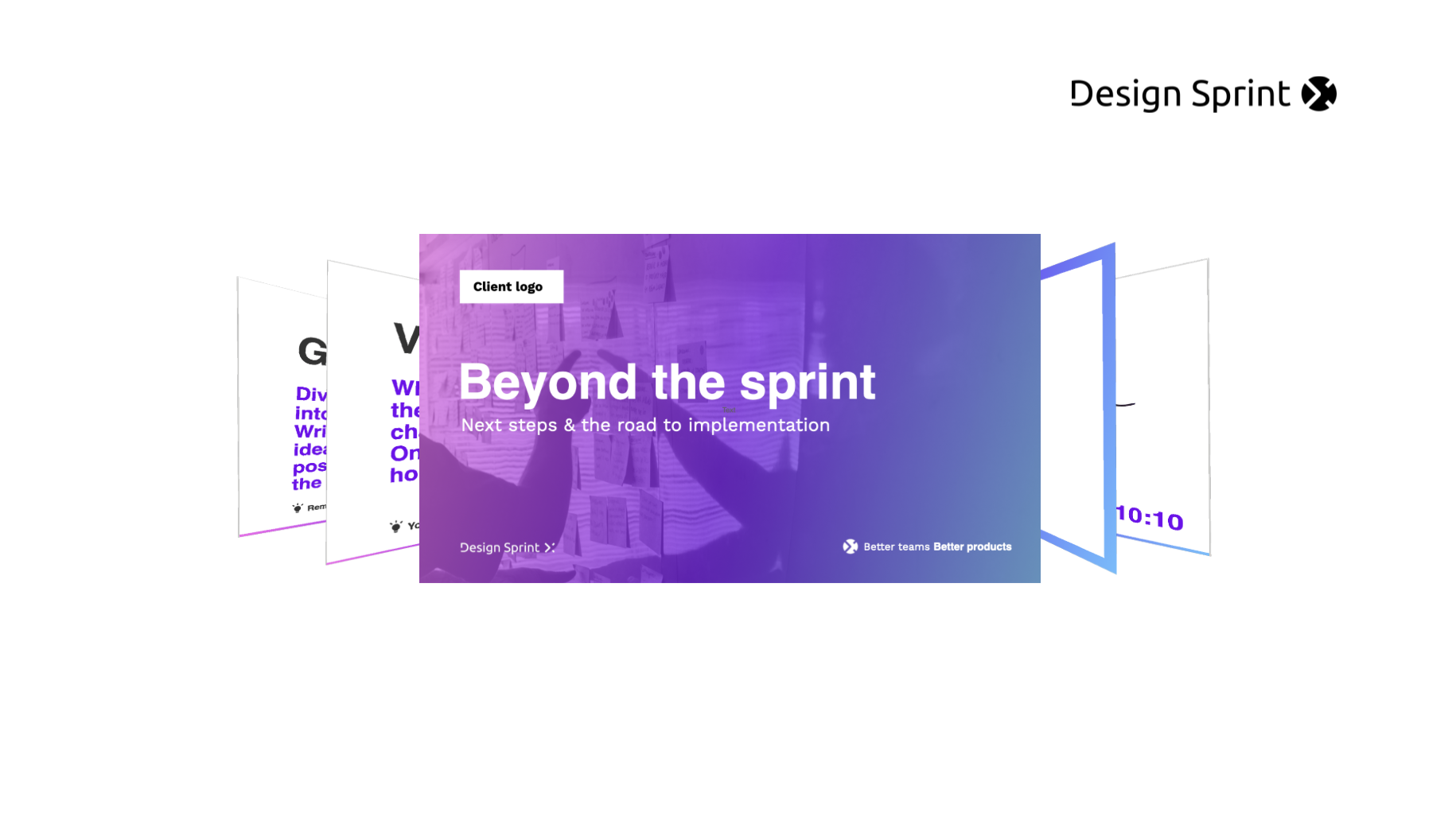
Beyond the sprint deck