
The 4 Cs of good meetings: why getting rid of meetings isn't always the answer
Written by Luke James Taylor, Design Sprint X Co-Founder
If your first reaction to a new meeting invite is exhaustion, we get it. At Design Sprint X, we’ve built our stance around protecting time, cutting unnecessary conversations, and challenging the culture of “let’s jump on a call” as a default solution. We are firmly anti-meeting when meetings are used as a substitute for clarity, ownership, or preparation.
But here’s the nuance: eliminating meetings entirely isn’t realistic, especially in large organisations or remote and hybrid environments. Complex work still requires shared understanding. The real question isn't "how do we eliminate meetings?" It's "how do we make the ones we have actually work?"
In this article, we're breaking down the 4 Cs of effective meetings: Context, Content, Congruency, and Continuity. Master these, and meetings become engines of progress instead of time sinks.
The remote work reality: why meetings matter more

Before we dive into the framework, let's acknowledge what's changed.
Between 2020 and 2023, the number of meetings tripled according to Microsoft's research. Remote employees now attend 50% more meetings than in-office staff, with the average worker attending 10 meetings per week.
Why? Because we're trying to recreate informal collaboration through formal structure. The quick "hey, got a minute?" at someone's desk became a 30-minute slack huddle. The spontaneous coffee chat became a scheduled check-in.
Here’s what’s interesting.
Remote work didn’t ruin productivity. In many cases, it improved it. Most people say they get more done at home. Fewer interruptions. More focused time. Less commuting. More control over their day.
So remote work isn’t the problem. What breaks down is how we collaborate inside it.
Without hallway chats or quick desk clarifications, everything gets pushed into formal meetings. And when those meetings lack structure, clarity, or a clear outcome, they multiply. One vague conversation turns into three follow-ups. A missing decision becomes another calendar invite.
The challenge: 86% of employees and executives attribute a lack of effective communication and collaboration as the leading causes of failures in the workplace. And only 30% of meetings are considered productive, with just 37% of workplace meetings actively using an agenda.
The opportunity: If we can fix how we meet, we unlock the full potential of remote and hybrid work.
The 4 Cs framework: what makes meetings actually work
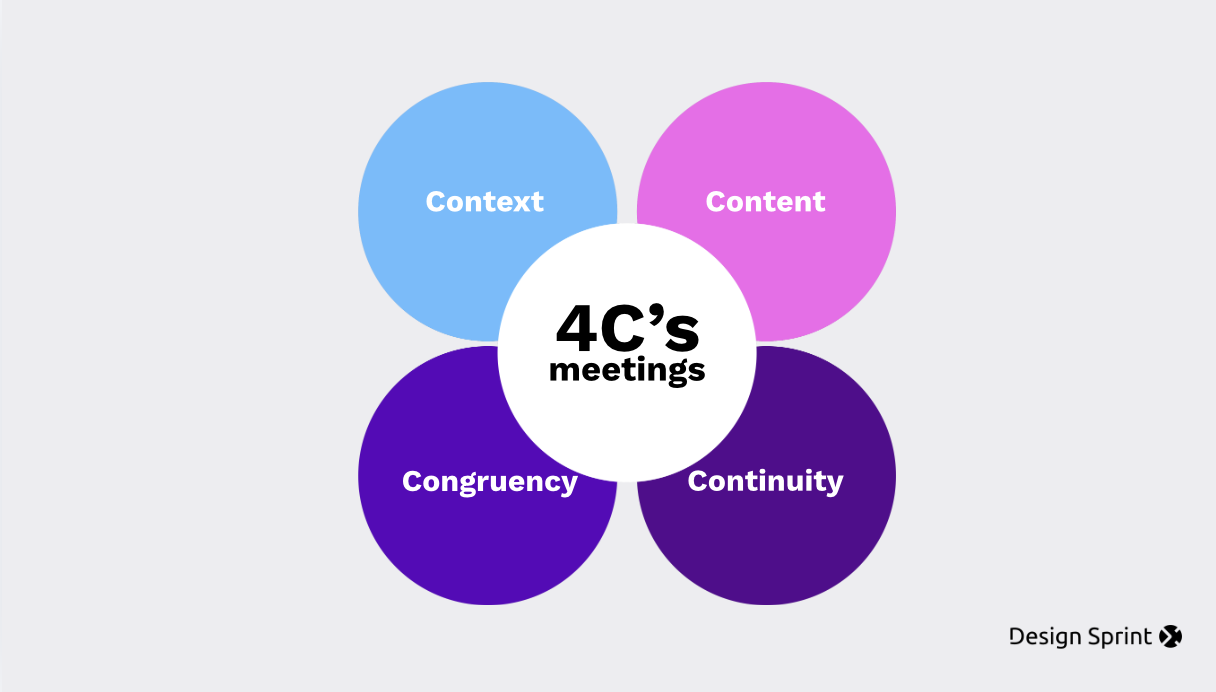
The 4 Cs framework comes from Navalent, an organisational consulting firm that studied what actually differentiates effective meetings from performative ones. Instead of focusing on hacks, tools, or trendy formats, they identified four foundational conditions that consistently determine whether a meeting drives progress or quietly wastes time.
The 4 Cs — context, content, congruency, and continuity — offer a clear lens for diagnosing why meetings fail and, more importantly, how to fix them.
Let’s break them down.
C1: Context (Why are we meeting?)
The problem: Most meetings happen because they're scheduled, not because they're needed.
Research from Stanford's Matt Abrahams, author of Think Faster, Talk Smarter, found that people often use meetings as Band-Aids for deeper communication issues. When communication isn't clear and consistent, people either put more meetings on the calendar, or more people show up because it's the only avenue for direct communication.
What Context means:
Every meeting must answer three questions before it's scheduled:
What decision needs to be made (or what specific outcome needs to be achieved)?
Why can't this happen asynchronously? (Email, Slack, Loom, shared doc?)
Who is the minimum viable audience for this decision to stick?
If you can't answer all three clearly, don't schedule the meeting.
Your action: Before your next meeting invite goes out, write a one-sentence purpose statement. If you can't, cancel the meeting.
C2: Content (What specifically will we cover?)
The problem: "Let's discuss the project" isn't content. It's a topic with no structure.
Structured meetings that follow a well-designed agenda are more effective. The agendas of effective meetings were: sent to participants beforehand, explained at the beginning of the meeting, and followed during the meeting.
What Content means:
An effective agenda isn't a list of topics,it's a sequence of questions to be answered.
Instead of:
"Marketing campaign"
"Q1 roadmap"
"Team updates"
Try:
"Should we launch the campaign in March or April? (15 min, Decision required)"
"Which 3 features make it into Q1? (20 min, Prioritisation exercise)"
Your action: Rewrite your next meeting agenda as a list of questions, with time allocations and decision/discussion labels. Share it 24 hours in advance.
C3: Congruency (does this align with what actually matters?)
The problem: We schedule meetings based on calendar availability, not strategic priority.
This is the most overlooked C, but it might be the most important. Congruency asks: Does this meeting's purpose align with our actual business goals and team priorities?
McKinsey found that only 41% of respondents say their organisations' decisions align with corporate strategy. That's a massive disconnect and meetings are where it shows up.
When meetings lack congruency:
Decisions get made that don't matter
Important decisions get postponed indefinitely
People show up but don't engage (because they don't see the relevance)
Meeting outcomes don't connect to action (because they're not tied to real priorities)
What Congruency means:
Before scheduling a meeting, ask:
Does this decision connect to our top 3 priorities this quarter?
Will this meeting outcome change what we do next week/month?
If we made no decision, would anyone notice?
If the answers are "no," "no," and "no," the meeting lacks congruency. Don't schedule it, or defer it until it does matter.
Your action: At the start of your next meeting, explicitly state: "This meeting connects to [strategic priority] by [specific connection]." If you can't make that statement confidently, postpone the meeting.
C4: Continuity (what happens after this meeting?)
The problem: Meetings end with vague agreements and no follow-through.
This is where most meetings fail.
There are five design characteristics that impact whether a meeting is perceived as "good": use of an agenda, keeping of minutes, punctuality, appropriate meeting environment, and having a meeting leader who ensures follow-through.
Yet research shows that 44% of workers say they dread meetings, and time wasted in unproductive meetings has doubled since 2019 to 5 hours per week. One of the primary reasons? Lack of clarity about next steps and accountability.
What Continuity means:
An effective meeting doesn't end when people leave the room. It ends when the agreed-upon actions are completed. Continuity ensures:
Clear action items (Who does what by when?)
Documented decisions (What was decided and why?)
Follow-up mechanisms (How will we track progress?)
Connection to next meeting (What needs to happen before we meet again?)
Without continuity, meetings become circular. You discuss the same topics week after week because nothing actually moves forward between sessions.
Your action: End every meeting by explicitly stating: "Before we wrap: Who is doing what by when? How will we know if it's done? When do we check progress?"
Why most meetings fail all 4 Cs & what to do about it
Now that you understand the framework, let's talk about why meetings consistently fail to meet even one of these criteria and how to fix it.
The typical meeting failure pattern:
Weak Context: "Let's sync on the project" (no specific purpose)
Vague Content: "Updates and discussion" (no structure or questions)
No Congruency: The meeting happens because it's scheduled, not because it matters this week
Zero Continuity: Meeting ends with "okay, great chat" and no action items
This pattern explains why remote workers think that a majority of meetings "could have been an email".
The remote work amplification:
The shift to remote work made these failures worse because:
Social loafing increases in virtual settings (people reduce effort when working remotely in groups)
Attention spans are shorter
Technical issues create friction
Multitasking is rampant
And what is the fix? To treat meetings like products
This means:
Before the meeting:
Write a purpose statement (Context)
Create a question-based agenda (Content)
Verify strategic alignment (Congruency)
Pre-assign action item owners (Continuity setup)
During the meeting:
Start with energy, appreciation or small talk
Use video
Set time properly
Don't over-invite
After the meeting:
Share summary within 24 hours
Check in before deadlines
Measure outcomes
The math: Spend 10 minutes designing a better meeting, save 40 minutes in the meeting itself. That's a 4x return on time investment.
Your meeting audit: how to apply the 4 Cs this week
Want to know if your meetings pass the 4 Cs test? Here's a simple audit you can run on your next three scheduled meetings:
Meeting Audit Checklist
If you’re not sure whether your meetings are helping or quietly draining momentum, run them through the 4 Cs audit. It takes a few minutes per meeting and forces a simple yes-or-no assessment of whether the session is justified, decision-focused, strategically aligned, and properly followed through.
The patterns are usually revealing. You’ll quickly see which meetings deserve protection, which need tightening, and which should be replaced entirely. Start with this week’s calendar and score them honestly.
The time savings:
If you audit 10 recurring meetings and:
Cancel 3 (30% elimination rate)
Shorten 4 by 50% (from 60 to 30 minutes)
Improve 3 with agendas (80% more efficient per research)
You save approximately 6-8 hours per week. That's nearly a full workday reclaimed.
When to run a design sprint instead of another meeting
Here's the practical question: When should you stop having meetings and run a Design Sprint instead?
You've had 3+ meetings on the same topic with no decision (you're in a loop)
Stakeholders keep saying "let's think about it more" (analysis paralysis)
The decision involves multiple departments (misalignment risk is high)
You're debating solutions without testing them (opinions vs. data)
Timeline pressure is real, but you're moving slowly (urgency exists but structure doesn't)
The meeting calendar shows 6+ "update" or "sync" calls (meeting debt is accumulating)
The threshold:
If a decision would typically require more than 10 hours of meetings spread across 4+ weeks, it's probably a sprint candidate. The sprint compresses that time while improving decision quality through structure and user testing.
Your next steps: making meetings work
Let's make this actionable. Here's what to do this week:
Monday: Audit your next 5 scheduled meetings using the 4 Cs checklist above.
Tuesday: For meetings scoring below 7, decide: Cancel, shorten, or restructure?
Wednesday: Rewrite one meeting agenda as questions with time allocations. Share it 24 hours in advance.
Thursday: In your next meeting, explicitly state at the start: "This meeting's purpose is [X]. We'll know it's successful if [Y]. It connects to [strategic priority]."
Friday: After one meeting this week, document action items within 1 hour and send to all attendees. Include: who, what, when.
Conclusion
You can't fully eliminate meetings. Not in remote work. Not in 2026. But you can make meetings worth the time they consume.
The 4 Cs—Context, Content, Congruency, and Continuity—aren't revolutionary. They're basic principles of good communication applied with discipline.
The opportunity is enormous. Companies that master structured decision-making in 2026—whether through better daily meetings or concentrated Design Sprints—will move faster, decide smarter, and win more than competitors still trapped in meeting theater.
The choice: Keep having the same meetings you're having now, or apply the 4 Cs and turn meetings into engines of progress.