The original Design Sprint
The five-day method we were known for as Design Sprint X. It shaped how we work and it still underpins everything we do — but we no longer run traditional design sprints for clients. HyperSprints have replaced them.
This page is kept for reference. You can still learn the method through our online courses, and the five-day slides remain free.
What is a design sprint?
A design sprint is a time-boxed, structured process that helps teams tackle big challenges through ideation, prototyping and testing ideas with real users. It was designed to answer critical business questions before anyone wrote a line of code.
It was created by Jake Knapp at Google Ventures in 2010, drawing on his work on products like Gmail and Google Hangouts, and refined with John Zeratsky and Braden Kowitz. It went on to be adopted by companies worldwide, from start-ups to Fortune 500 companies — and for years it was the core of our work.
The five stages
- 01
Understand
Understand the problem and gather insights.
- 02
Sketch
Sketch potential solutions and brainstorm ideas.
- 03
Decide
Decide on the most promising solution and create a plan.
- 04
Prototype
Build a realistic model of the chosen solution.
- 05
Test
Test the prototype with real users to gather feedback and validate assumptions.
Each stage traditionally took a day. HyperSprints keep the same principles and get there ten times faster.
Why teams used them
Accelerate innovation
Quickly turn ideas into testable prototypes, reducing time-to-market and staying ahead of competitors.
Enhance collaboration
Align people from different departments so diverse perspectives and expertise shape the solution.
Reduce risk
Validate ideas with real users early, and make informed decisions before significant resources are invested.
Boost efficiency
Strip the problem-solving process back to what matters, and focus on what will make an impact.
Learn the method online
Self-paced courses that take you from first-time participant to confident facilitator, with real examples, templates and facilitation guides.
 Introductory courseIndigoThe foundation: what a design sprint is, when to use one and how to pick the right challenge.£99View course →
 Participator programmeVioletFor the people in the room: contribute with confidence, back up the facilitator and keep momentum.£199View course →
 Facilitator masteryUltra VioletLearn to lead: every day of the sprint, every exercise, plus the full template and material pack.£497View course →
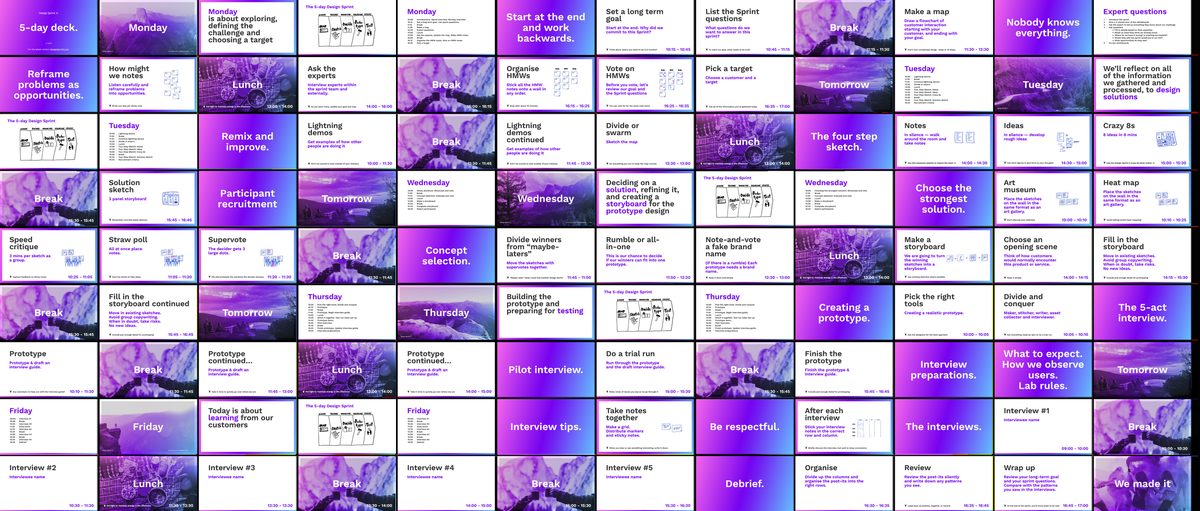
The free five-day deck
The deck we ran the five-day sprint from: over 100 slides with facilitator notes and tips for every exercise, in Keynote, PowerPoint and PDF. More than 2,000 professionals have used it.
Frequently asked
What is a design sprint?
A five-day process for solving complex problems and testing new ideas through rapid prototyping and user feedback. Teams moved from understanding the problem on day one, to sketching solutions, deciding on the best approach, building a prototype, and testing it with real users by the end of the week.
Do you still run design sprints?
Not in their traditional five-day form. HyperSprints have replaced them: the same principles — a cross-functional team, a real problem, a decision tested with customers — with AI accelerating the work, ten times faster than a traditional design sprint.
Who took part in a design sprint?
Typically five to seven people from different departments — product managers, designers, engineers, marketers and other key stakeholders — so the solution addressed every side of the problem.
What problems were design sprints used for?
New products and services, improvements to existing ones, and internal process issues. They worked best on problems that were complex, needed fresh thinking and benefited from fast feedback from real users.
Can I still learn to run one?
Yes. Our self-paced online courses teach the full method, and the five-day slides are still free to download.
What should I use instead?
If you are working out how AI should change a piece of work, a HyperSprint. Get in touch and we will tell you honestly whether it fits.
This is our original method. HyperSprints are the updated way we work — ten times faster than a traditional design sprint.