Get the keyboard off the expert
Every AI-assisted workshop has one person who’s great at prompting. By lunch they’re running it, and the quiet half of the room has stopped contributing.
What changed
Facilitation was always about sharing the room. Stopping the loud person, drawing out the quiet one, making sure the best idea wins rather than the most senior. The model added a new way to lose the room: the keyboard.
Whoever holds it shapes every output. They phrase the prompt, so their framing is in everything. They decide when to regenerate. They choose which result to show. None of this is malicious. They’re just fast, and fast wins in a room, and by the afternoon the whole wall has one person’s fingerprints on it.
The skill
Three fixes, used together. Everyone sees and edits the brief, so the framing is shared before it’s typed. The keyboard rotates, every exercise, no exceptions. And there’s a standing role whose only job is to question what comes back.
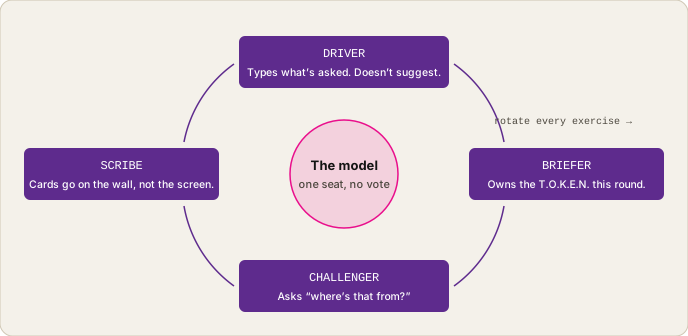
Fig. 9 — Four roles, one model, everyone moves one seat per exercise. Nobody drives twice in a row.
Driver holds the keyboard and types what the group asks for. They don’t suggest, they don’t regenerate on their own, they don’t pick which result to show. If they’re the prompting expert, this is the role where their skill helps without their framing taking over.
Briefer owns the T.O.K.E.N. for the round. They read it out before the driver types. If the brief changes mid-exercise, the briefer changes it, on the wall, where everyone can see.
Challenger has one question, which they ask of every output: where’s that from? Which part of the brief produced that idea, which note supports that summary line, what would have to be true for that objection to matter. It’s the Day 5 and Day 7 skills, given to one person as a job.
Scribe gets the output off the screen and onto cards. This sounds clerical. It’s the move that stops the screen being the centre of the room. Once ideas are on the wall in the same format as the human ones, the model’s contribution stops feeling special.
What goes wrong
Rotation gets skipped because the expert is faster. “Just let Sam drive, we’re behind.” We’ve done this. Sam drives, Sam frames, the afternoon is Sam’s. The two minutes you save on each exercise cost you the room’s ownership of the outcome, and ownership is the whole reason people adopt what comes out of a workshop. Rotate anyway. Let it be slower.
And the challenger role dies if the facilitator doesn’t protect it. The first time the challenger asks “where’s that from?” and the senior person in the room sighs, the role is over. Back the challenger, every time, out loud.
Run it Monday
- Four cards: Driver, Briefer, Challenger, Scribe. Deal them. Rotate one seat per exercise.
- The brief lives on the wall. Nobody types a prompt that isn’t on it.
- Driver rule, said out loud: you build what’s asked, you don’t suggest.
- Everything the model makes goes onto cards in the same format as the humans’ work.
- When the challenger asks their question, the facilitator waits for an answer. Every time.
People adopt what they help create. One keyboard means one creator.
If this sounds like your organisation. Most organisations have a few 10x individuals using AI brilliantly and a lot of teams watching them. A HyperSprint puts the whole team on the redesign, so what comes out is theirs. Talk to us about where that would help most.
The four role cards are in the facilitation deck. Print them, deal them, rotate.