Ten options that are really one
Ask a model for options and you get variations. Getting something different means changing the question, not asking it again.
What changed
The old scarcity in a workshop was ideas. You ran Crazy 8s because getting eight out of each person was hard. Now the scarcity is difference. The model will give you fifty ideas and forty of them will be the same idea wearing different hats: a chatbot, an assistant, a smart helper, a conversational guide.
Volume used to be the facilitator’s job. Now it’s divergence.
The skill
Direct the exploration. Don’t ask for more; ask under different conditions. Each new constraint, assumption or service model forces the model out of its default basin. Then put everything on the wall and cluster it, so the room can see which “options” were one option all along.
The constraints we reach for most:
- No screen. Solve it with paper, post, a phone call, a person.
- No people. Fully automated, end to end. Usually wrong, often revealing.
- Ten times cheaper. What would you cut to make it nearly free?
- Different business model. Subscription, pay-per-use, bundled with something else, given away.
- A different customer entirely. Solve it for the call handler instead of the customer. For the customer’s daughter.
- The opposite assumption. “Assume customers want more contact, not less.”
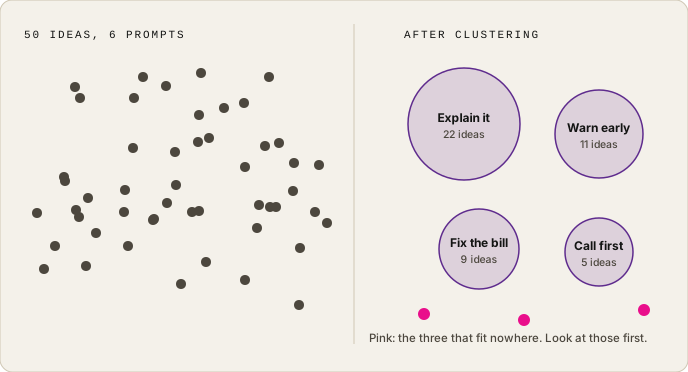
Fig. 4 — The wall from the October sprint. Six prompts, fifty cards, four actual ideas and three outliers.
That wall is from the high-bill sprint. Six prompts, one per constraint, fifty cards. Clustering took twelve minutes. Twenty-two of the fifty were “explain the bill better” in different clothes. The three outliers came from the “different customer” prompt: solve it for the call handler. One of them, giving the handler a button to post a one-page explainer during the call, is the thing that got built.
What goes wrong
Teams cluster by surface. Everything with “SMS” in it goes together, everything with “app” goes together. That’s grouping by channel, and it hides the fact that an SMS and an app notification saying the same thing are the same idea. Cluster by what the idea does for the customer. We say it out loud before the exercise: “What does this change for them? Group by that.”
And don’t let the biggest cluster win by weight. Twenty-two cards in a pile means the model found that idea easy to generate. It doesn’t mean it’s the best one. It usually means it’s the most obvious.
Run it Monday
- Write the brief (Day 2). Then run it six times, once per constraint. Same brief, different Nuance line.
- Print every idea as a card. No screens during clustering.
- Cluster by what it does for the customer, not by channel or technology.
- Name each cluster in three words. Count the cards. Say out loud that a big pile is not a vote.
- Look at the outliers before you look at the piles.
More isn’t different. Different comes from changing the question.
The six constraint prompts, the clustering slide and the twelve-minute timebox are in the facilitation deck.