Where AI goes in the agenda changes what the room thinks
Put the model first and every human idea afterwards is a variation on its answer. Put it last and nobody uses it. The order is a decision.
What changed
Anchoring was always a facilitation problem. The first idea spoken out loud pulls the others toward it, which is why good workshops start with silent, individual work. The model is the loudest first voice there has ever been. It speaks in finished sentences, it’s confident, and it produces ten ideas before anyone has uncapped a pen.
So the question isn’t whether to use it for ideation. It’s when.
The skill
There are three sequences we use. None of them is right. Each is right for a particular room.
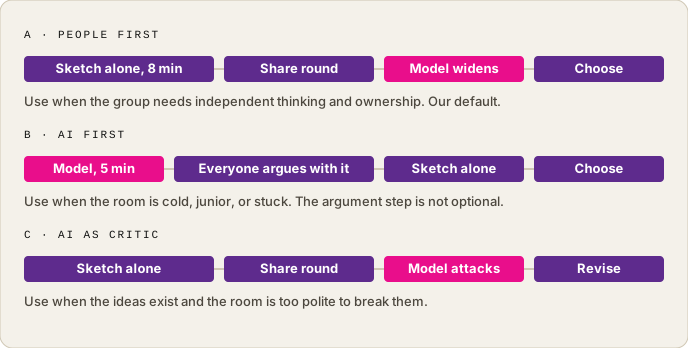
Fig. 3 — Three sequences. Pink is the model’s slot. Where it sits decides what the room does with it.
People first protects independent thinking. Eight minutes alone with a pen, then share round the table, then the model gets the brief plus “here are our ten, give us ten we haven’t thought of”. Both sets go on the wall. The human ideas have had their moment to exist without competition. This is our default and I’d guess it’s right 70% of the time.
AI first is for a room that’s cold. A new team, a vague brief, a Monday morning after a reorg. Let the model go first for five minutes, then make everyone argue with what it produced before anyone sketches. The arguing is the point: it warms the room up and it breaks the anchor. Skip the arguing and you’ve just handed the day to the model.
AI as critic is for when the ideas already exist and the team is too polite to break them. Sketch, share, then ask the model to attack each one. Stress-testing properly is Day 5; here it’s the position in the sequence that matters.
What goes wrong
We opened a workshop with the model once because the sponsor wanted to “show the team what it can do”. It produced a confident list. The team spent the next two hours producing slight variants of that list. When we looked at the wall at lunch, nineteen of twenty-two ideas traced back to the first five minutes. We rebooted the afternoon with silent sketching and got a different wall.
The other mistake is not saying why. If you choose people-first, tell the room: “We’re doing you first because I want ideas that are yours.” If you choose AI-first, tell them: “It’s going first so you’ve got something to disagree with.” The reason changes how they behave.
Run it Monday
- Before the session, decide which of the three the room needs. Write it on the agenda with a one-line reason.
- Say the reason out loud when you get to that block.
- Whichever you pick, the model’s output goes on the wall in the same format as the humans’. Same cards, same size.
- At the end, count how many chosen ideas came from which source. Tell the team.
The model will go first if you let it. Decide on purpose, and say why.
All three sequences, timed, with the prompts for each, are in the facilitation deck.