AI investment is rising. Adoption is not keeping up
The spend is real, the tools are everywhere, and most organisations still cannot point to a workflow that runs differently. A look at what the numbers actually say, and what they are quietly telling leaders to do next.
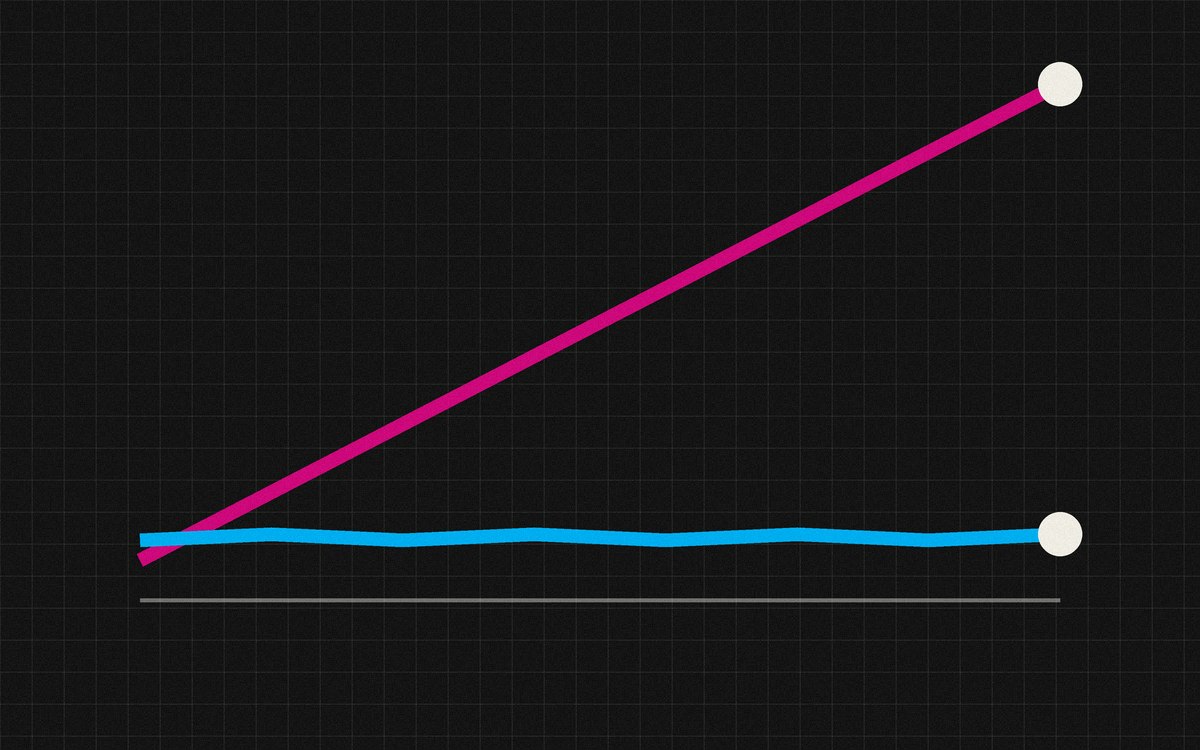
Every survey of senior leaders tells the same story from the top: AI is a priority, the budget is committed, the tools are being rolled out. EY puts the share of senior leaders investing in AI at 95%. That is no longer a trend — it is the baseline.
Read the same surveys from the bottom up and a different picture appears. Deloitte finds 84% of organisations have not redesigned work around AI. Slalom finds only 21% of AI use cases scale enterprise-wide. Kearney finds 46% of proofs of concept are scrapped before deployment. The money is going in. The change is not coming out.
This piece is about the gap between those two sets of numbers — why it exists, why it is widening, and what the organisations that have closed it did differently.
What the investment is actually buying
Most enterprise AI spend to date has gone on three things: licences, pilots and training. All three are sensible, all three are easy to approve, and all three share a limitation that only becomes visible later. They change what individuals can do without changing what the organisation does.
- Licences make a tool available. They do not decide what it is for, who uses it, or which step in a process it replaces.
- Pilots prove a capability works in controlled conditions. They rarely prove that a team will keep using it under normal load.
- Training raises individual fluency. It does nothing to the approval gates, meeting cadences and handoffs that determine how fast work actually moves.
The result is a familiar shape: strong adoption at the individual level, flat results at the organisational level, and a growing suspicion in the boardroom that the investment is not landing.
The numbers, in order
Put the headline figures in sequence and they read as a funnel, with the leaks visible at each stage:
- 95% of senior leaders are investing in AI (EY). Intent is near-universal.
- 84% have not redesigned work around AI (Deloitte). The work itself is largely untouched.
- 46% of AI proofs of concept are scrapped before deployment (Kearney). Nearly half of what is started is abandoned.
- 21% of AI use cases scale enterprise-wide (Slalom). Of what survives, only a fifth spreads.
- 70% of the value of AI depends on people and workforce change, not technology (BCG). The part being under-invested in is the part that carries most of the return.
The constraint has moved. It is no longer access to capable tools. It is the organisation’s ability to change how work is done once the tools are in the building.
Why the gap is widening, not closing
It would be reasonable to expect adoption to catch up with investment over time. In many organisations the opposite is happening, for three reasons.
First, model capability is improving faster than organisational process can absorb it. Every quarter the tools can do more, which raises the ceiling on what is possible and does nothing to the floor of what is practised. The distance between the two grows.
Second, pilot fatigue. Teams that have been through two or three demonstrations that led nowhere become harder to mobilise for a fourth, however good the technology. The organisational memory of “we tried that” is a real cost and it compounds.
Third, the quiet decoupling of AI programmes from business outcomes. When success is measured in licences activated, prompts run and people trained, the programme can report green for years while nothing a customer would notice has changed. Those measures are not wrong, but they describe inputs, and the board is asking about outputs.
What the organisations closing the gap have in common
The pattern across the organisations that have converted AI investment into visible operational change is less dramatic than the technology would suggest. None of them found a better model. All of them changed the unit of work.
- They picked one workflow with a real business consequence, rather than a portfolio of safe experiments.
- They baselined it — time, cost, error rate — before touching anything, so the improvement could be proven rather than asserted.
- They redesigned the whole workflow, including the approvals and the meeting cadence around it, rather than inserting a tool into an unchanged process.
- They tested the redesign with the people who do the work, on real volume, before any rollout decision.
- They finished with a decision and an owner — scale, pilot, build or stop — rather than a recommendation that went into a queue.
Each of those steps is organisational rather than technical. That is why they are skipped: they require permission to change how a decision gets made, which is harder to obtain than a budget line.
What this means for the next twelve months
The investment phase is not ending; the surveys suggest it is accelerating. But the questions leaders are being asked are changing. “Are we investing in AI?” has been answered. “What has changed because of it?” has not, and the gap between the two is where credibility is now being won and lost.
The organisations that will be able to answer the second question a year from now are the ones that stop measuring adoption and start measuring elapsed time on specific workflows — because elapsed time contains the queues, the handoffs and the waiting, and it is the only number that has stubbornly refused to move.
Investment has done its job. It put the capability in the building. The return now depends on something investment cannot buy: the willingness to redesign the work.
Sources
- EY — CEO Outlook: 95% of senior leaders investing in AI.
- Deloitte — State of Generative AI in the Enterprise: 84% have not redesigned work around AI.
- Slalom — AI use-case scaling research: 21% scale enterprise-wide.
- Kearney — AI proof-of-concept study: 46% scrapped before deployment.
- BCG — AI value realisation: 70% of value depends on people and workforce change.